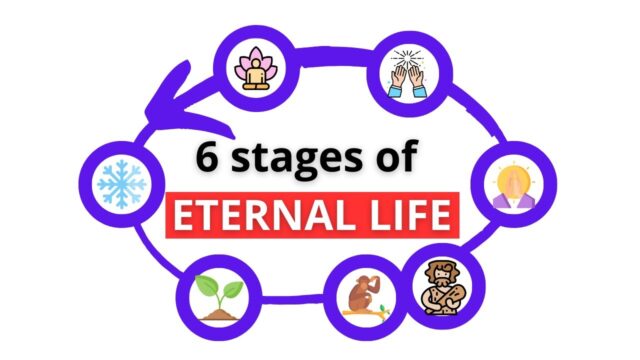
This is the strongest objection anyone raises against the whole structure, and to the video's credit it puts it in the harshest available form.
If existence is eternal, then development has had unlimited time. Whatever the process is, it should have finished. So why is anybody still struggling with anything?
Why "finished" is the wrong target
The answer turns on noticing that the objection assumes a destination.
Eternal life, in the strict sense from the definition of eternity, is not a very long journey with an end. It never started and it does not stop. And a process without an end cannot be measured by how close it is to finishing, because finishing is not one of the things available to it.
So "why isn't it done yet" is asking a timely question of an eternal structure — the confusion the two purposes of life is built to separate.
Renewal, and what it costs
The positive argument is about consciousness needing renewal.
A consciousness that stopped encountering anything new would not be a perfected consciousness. It would be one with nothing left to register — the state the contrast principle rules out. So renewal is not an optional extra; it is the condition of remaining a being that experiences at all.
And renewal has a price. New contrasts require conditions that differ from the ones already exhausted, which means a period of imperfection is not a failure of the process but the mechanism by which it continues. The video's phrase is worth keeping: the perfect life is a timely creation — something that gets built, enjoyed, and then, necessarily, left.
Two worlds
The section comparing the spiritual and physical worlds does useful work here.
The spiritual side is described as the region where the light half of the cycle is experienced. The physical is where contrast is available in the sharp form that produces development. Neither is a reward or a punishment; they are the two halves the alternation runs between.
That reframes the question one more time. It is not "why have we not arrived" but "which half are we currently in" — and the difficulty of the answer stops being evidence that something has gone wrong.
What it does not claim
Worth stating plainly, since this argument is easy to over-read. Nothing here says a particular hardship was necessary, or that improving conditions is pointless. The claim is about why a permanently finished state is not on the menu, not about any specific thing you are dealing with.
Key ideas
- The objection assumes development has a destination; an eternal process has none.
- "Why isn't it finished" applies a timely standard to an eternal structure.
- Consciousness has to be renewed, or it stops registering anything — renewal is a condition of remaining alive.
- Renewal requires new contrasts, so a period of imperfection is the mechanism rather than a fault.
- A perfect life is a timely creation: something built and then necessarily left behind.
Chapters
About this article. It summarises the video above from The Eternal World Picture. The writings of Martinus Thomsen are published by the Martinus Institute.