Development is usually pictured as ascent: you start in difficulty and climb toward something better, and progress is measured by distance from the bottom.
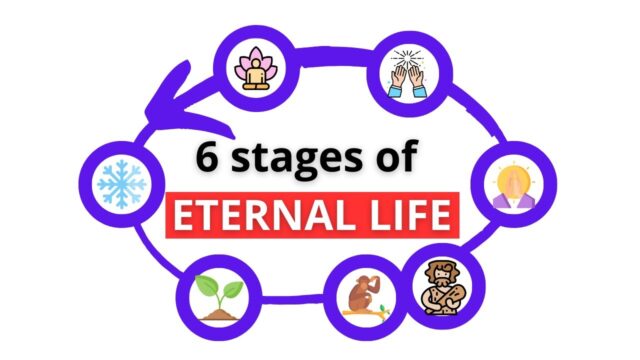
This video replaces that picture with a different one. The path is not a climb. It is a movement back and forth between light and darkness, repeated indefinitely.
Why it cannot be a climb
The reasoning comes from the contrast principle. If experience requires contrast, then the destination people imagine — permanent light, difficulty behind you — is not the top of the climb. It is a state in which nothing further can be experienced.
So no arrangement that terminates in unbroken light can be what development is heading for. What is left is alternation, which is not a lesser version of the ascent but the only shape that keeps experience possible.
The spiritual world as the other half
The section on the spiritual world explains where the light half is actually spent.
The physical world provides contrast in its sharpest form — this is where the dark half is available and where the development that requires it happens. The spiritual world is where the light half is experienced.
The swing between them is what reincarnation looks like when you stop thinking of it as a series of physical lives with gaps, and start thinking of it as one continuous alternation with two phases.
Hunger and satiation
The longest section, and the engine of the whole thing.
An appetite is exhausted by being satisfied. Not interrupted — used up. And once used up, a different appetite takes its place. That is the mechanism, and it is observable on any timescale you like: the meal you wanted intensely and cannot face a second helping of, the ambition that stops motivating the day after it is achieved.
Applied to the path of life, it explains why the swing is self-driving. Time in the light exhausts the appetite for light, and an appetite for contrast takes its place. No external force is required to push a being back into difficulty; the appetite does it, and the video's phrase for this is that we naturally seek contrast.
That is a genuinely uncomfortable idea, and it explains something otherwise puzzling — why comfortable, secure lives so reliably generate restlessness.
Where we are
The closing section locates humanity on the path, and the answer is consistent with the rest of the material: mid-transition, with the animal stage behind and the human stage not yet complete.
The video's framing throughout is that this is testable against your own experience and reasoning — "as verifiable as basic mathematics" — rather than something to be believed. Whether it meets that standard is exactly what it is inviting you to check.
Key ideas
- The path of life is an alternation between light and darkness, not a climb out of one into the other.
- Permanent light cannot be the destination, because experience requires contrast.
- The physical world supplies the dark half; the spiritual world is where the light half is experienced.
- The hunger and satiation principle drives the swing: satisfying an appetite exhausts it and a new one takes its place.
- Beings therefore seek contrast rather than being forced into it — which explains restlessness in comfortable lives.
Chapters
About this article. It summarises the video above from The Eternal World Picture. The writings of Martinus Thomsen are published by the Martinus Institute.