The popular version of karma is a court: you do something wrong, a sentence is handed down, and the universe collects. It is a satisfying picture, particularly when applied to other people, and on Martinus’ account it is the wrong picture.
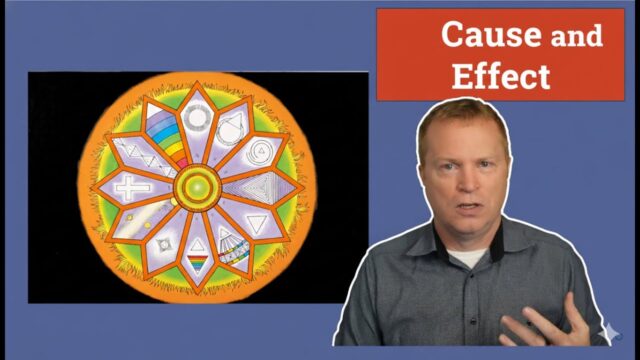
He described karma as the fate principle — closer to a mirror than to a court.
A mirror, not a sentence
A mirror has no opinion about what it reflects and no interest in your improvement. It returns what is put in front of it. On this account, karma works the same way: what you send out comes back, not as a verdict but as the same thing arriving from the other direction.
That difference matters. A punishment is finished when it has been served. A reflection is only finished when it has been understood.
Why it needs more than one life
The video is clear that the principle operates across reincarnations, and that it has to. Consequences that arrive after the being has ceased to exist teach nobody anything, and consequences that arrive within a single life are frequently too fast or too slow to connect to their cause.
Given a longer arc, the return can arrive when it is actually intelligible.
What it builds
The function, as the video sets it out, is empathy. Understanding what an action costs is not the same as being told what it costs, and the only reliable route from one to the other is experiencing it. Karma is presented as the mechanism that arranges that experience.
It is also described as adaptive: the return is calibrated to where the being currently is rather than applied at a fixed rate. And it is described as exhaustible — the process has an end state, in which there is nothing left to return.
The wider frame
Underneath sits the same structure as the rest of the material: a universe that is itself a living being, within which this is happening. That is the point at which karma stops looking like a rule imposed from outside and starts looking like a property of the system.
The longer treatment of how this connects to development is in reincarnation and karma.
Key ideas
- Martinus called karma the fate principle and described it as a mirror rather than a punishment.
- The principle operates across reincarnations, because consequences need time to become intelligible.
- Its function is the construction of empathy through experienced consequence.
- Karma is described as adapting to the being’s current stage rather than applying at a fixed rate.
- It is exhaustible: the process has an end state in which nothing remains to return.
Chapters
About this article. It summarises the video above from The Eternal World Picture. The writings of Martinus Thomsen are published by the Martinus Institute.