You arrive already formed. Your temperament, your particular fears, the specific way you notice things — none of it was chosen, and all of it was there before you could have had a say. The obvious question, which almost nobody asks, is: from where?
There is a matching problem at the other end. Someone spends eighty years becoming wiser, kinder, more patient, and then it stops. If this life is the whole of it, that accumulation simply ends. The video’s starting point is that neither end of this holds together.
What continues, and what does not
Martinus’ answer is that the living being continues while the physical body is temporary. Reincarnation here is not an escape into some other kind of creature; it is a continuing human journey in which each life starts from where the last one finished.
The obvious objection follows immediately: if there were previous lives, why is there no memory of them? The answer the video gives is that development carries forward as capacity rather than as recollection. Nobody remembers learning to walk, and the ability is unaffected. On this account, what has been genuinely understood becomes part of what you are; what has not yet been understood returns as a future difficulty.
Karma as a circuit, not a sentence
Karma is described as the mechanism through which that learning happens — a balance principle in which what you send into the world completes a circuit and returns to you. The point is not retribution. The point is that there is no other way to learn what an action feels like from the receiving end.
Experiencing the effect of harm is presented as how the capacity for medlidenhed — compassion, literally suffering-with — actually gets built. The video treats this as the turning point of the whole process. Once the cost to another being is fully understood, harming them stops being available, and not because a rule forbids it.
The spiral cycle
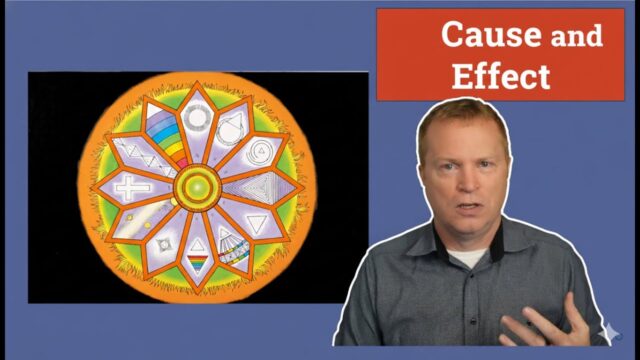
All of this sits inside a larger structure Martinus called the spiral cycle (spiralkredsløbet): six broad kingdoms of experience, from the mineral and plant kingdoms through animal and human existence and onward. It is called a spiral rather than a circle because development returns to familiar material at a higher level rather than repeating it.
Humanity, on this account, is mid-transition between the animal and the human kingdom. Self-interest, competition and group loyalty are still in place; compassion, cooperation, science and art are growing alongside them. The world looks unfinished because it is unfinished — that is the claim, and it is meant to be examined rather than accepted.
What changes if the map is right
The video is careful not to say that difficulty stops hurting. What it offers is a different reading of it: recurring tendencies, relationships and obstacles as the material development is made from rather than as noise. One life stays meaningful. It just stops being the whole book.
Key ideas
- Life is presented as a continuing process rather than a single isolated existence.
- Development carries forward as capacity, not as memory — which is why previous lives leave no recollection.
- Karma is framed as a balance principle: what is sent out returns, so the consequence can be understood from both sides.
- Compassion (medlidenhed) is built through lived experience of consequence, and is the turning point of the process.
- The spiral cycle places humanity mid-transition between the animal and human kingdoms, which is offered as the reason the world looks unfinished.
About this article. It summarises the video above from The Eternal World Picture. The writings of Martinus Thomsen are published by the Martinus Institute.