The earlier video on eternity fixed the definition: no beginning, no end, and not to be confused with a very long time. This one asks the harder question — whether something with those properties can be understood at all, and what kind of understanding is even available.
No details, and why that is the point
The chapter heading is no details, and it is doing real work.
Eternity cannot have features, because a feature is something that could be otherwise, and something that could be otherwise is not eternal. Every property you might attach to it would be a limitation, and a limited eternity is a contradiction.
So the honest description is close to empty: it just is. That reads as an evasion until you see that any richer description would falsify the thing being described.
Unmanifested
The technical term is unmanifested — real, but not appearing as any particular thing.
This is the same category the I falls into in the analysis of the living being. Not absent, and not observable; the condition for things appearing rather than one of the things that appears.
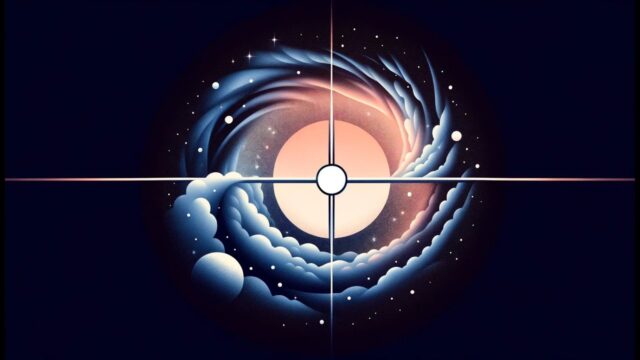
Which explains why eternity resists being pictured. Picturing is exactly the operation it does not submit to, and the failure to visualise it is not a failure of imagination — it is the concept behaving correctly.
Why it cannot come into existence
A short section with a clean argument, and it forecloses the obvious question.
Eternity could not have come into being, because coming into being is what timely things do. Whatever begins is, by definition, not eternal. So asking where eternity came from is not a hard question awaiting an answer; it is a malformed question, in the same way as asking what is north of the North Pole.
Zero, again
The parallel with zero returns here, having also appeared in the most basic meaning of being alive, and it is the most useful handle in the video.
Zero has no magnitude. You cannot point at a quantity of it. And it is not a gap in the number system — it is what the system is arranged around, and arithmetic does not work without it.
That gives a workable model for a whole class of ideas here: something with no properties of its own that everything else is measured from. We are entirely comfortable with this in mathematics and find it strange in metaphysics, which may be a fact about familiarity rather than about difficulty.
The eternal principles
The closing section connects eternity to the eternal principles — the structural rules that do not change and that govern the cycles of life, death and renewal.
That is what makes eternity usable rather than merely contemplated. You cannot observe eternity directly, but you can observe what follows from it: principles that hold everywhere, and the cycles they produce.
Key ideas
- Eternity has no details, because any feature would be a limitation and a limited eternity is a contradiction.
- It is unmanifested — real but never appearing as a particular thing, like the I.
- Failure to picture it is the concept working correctly, not a failure of imagination.
- Eternity cannot have come into existence; asking where it came from is a malformed question.
- Zero is the working model: no magnitude of its own, yet the point the whole system is arranged around.
Chapters
About this article. It summarises the video above from The Eternal World Picture. The writings of Martinus Thomsen are published by the Martinus Institute.