There is a moment most people know, and it does not usually arrive at a convenient hour. Something has happened, and the only honest question left is: why?
Not “is there a silver lining”. The real question underneath is whether the universe is the kind of place where what happens to you means anything at all, or whether it is a process that is fundamentally indifferent and we are inside it.
Three answers that do not hold
The video works through three world pictures that have tried this question, and shows each one failing differently. Animism gives events intention but no coherent structure. Religion supplies a plan and then declines to show it. Materialism is honest about not knowing, which is a virtue, but that honesty leaves the question exactly where it found it.
None of these is presented as stupid. Each is presented as insufficient in a specific way, which is a more useful thing to establish.
What a map would have to do
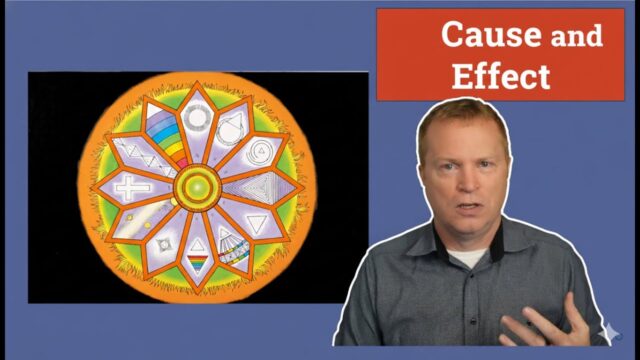
What Martinus offers instead, on the video’s framing, is not a fourth belief but a different category of thing: a structure that can be examined. Three components make suffering coherent rather than arbitrary — a living universe, many lives, and cause and effect that reaches across those lives.
Take any one away and the coherence goes with it. That is why the pieces of this material keep referring to each other rather than standing alone.
What suffering is building
The video sets out the sequence explicitly: ignorance leads to harm; harm returns as experience; returned experience forces development; development produces immunity to that particular kind of ignorance; and the accumulation of that process is what Martinus calls all-love.
Read as a whole, the claim is that suffering is not a by-product of the process but the mechanism of it — which is a strong claim, and the video presents it as something to weigh rather than to adopt.
Its closing position is the one worth repeating: you are not being asked to believe any of it. You are being asked to look at the structure and see whether it accounts for what you have actually observed.
Key ideas
- The underlying question is whether the universe is the kind of place where events mean anything.
- Animism, religion and materialism are each shown to fall short in a specific way rather than dismissed.
- A living universe, many lives, and cause and effect across lives are presented as the three things that make suffering coherent.
- The sequence runs: ignorance, harm, returned experience, forced development, immunity, all-love.
- The video explicitly does not ask for belief — it asks whether the structure accounts for what you have seen.
Chapters
About this article. It summarises the video above from The Eternal World Picture. The writings of Martinus Thomsen are published by the Martinus Institute. The video cites Livets Bog 2 (§585, §608), Grand Kursus (§193, §266) and Det Evige Verdensbillede 5 (§74.1).