Ask most people who they are and you get a biography: a name, a job, a history, a set of preferences. None of that survives much scrutiny. The job changes, the preferences change, the body replaces most of itself. Something is doing the changing, and it is not any of the things on the list.
This is the second video in the introduction series, and it takes up the most basic question in Martinus’ work: what a living being is at the level where nothing can be removed.
Three conditions, not one
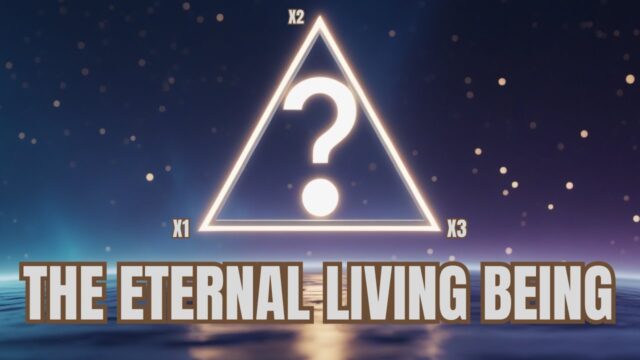
Martinus’ answer is that a living being requires three things simultaneously. He labelled them x1, x2 and x3, and the labels matter less than the structure.
x1 is the I — the one who experiences. Not a thought, not a feeling, not an image, but whatever it is that has thoughts, feelings and images. x2 is the ability to create and perceive — the apparatus through which anything can be done or registered at all. x3 is the created — everything that ability has actually produced: bodies, thoughts, actions, the whole visible output.
Why it has to be all three
The video does not simply assert the three; it argues for them by removing each in turn. Take away the I and there is nobody for the experience to happen to — creation with no creator, perception with nothing perceiving. Take away the ability to create and perceive and the I is sealed off, unable to act or register anything. Take away the created and the ability has produced nothing, which means it has not been exercised at all.
Each removal produces something that cannot be a living being. That is the shape of the argument: not that the three are pleasing or traditional, but that the concept collapses without any one of them.
Living beings inside living beings
The analysis then does something unusual: it scales. Your cells meet the same three conditions. They act, they respond, they have a history. On this account they are living beings, and they are living beings inside you.
Run the logic upward instead of downward and you are the cell. You act inside a larger organism, which acts inside something larger again. The video follows that chain to its end: an all-encompassing living being whose body is the universe. What religions have named God arrives here not as an article of faith but as the last step of the analysis.
You are the middle layer
The practical consequence is a change of position. You are not a small isolated thing looking out at a large indifferent thing. You are a layer — made of living beings, part of a living being. Whatever is true of you at your scale is presented as true at every other scale too.
That structure is what the rest of the material is built on. Reincarnation and karma only make sense once there is something that continues, and this is the analysis of what continues.
Key ideas
- A living being requires three things at once: the I (x1), the ability to create and perceive (x2), and the created (x3).
- The argument works by removal — take away any one and what is left cannot be a living being.
- The analysis applies at every scale, so your cells qualify as living beings in their own right.
- Run the same logic upward and it terminates in one all-encompassing living being — what Martinus identifies with God.
- This is offered as a conclusion drawn from the analysis rather than as an object of belief.
Chapters
About this article. It summarises the video above from The Eternal World Picture. The writings of Martinus Thomsen are published by the Martinus Institute.