This is where the channel began, and it is still the best single place to start. Twenty minutes, no assumed background, and a pass over the whole structure rather than a deep dive into one corner of it.
The stated purpose is worth repeating, because it explains the tone of everything that followed: to make Martinus useful to ordinary people who might get something out of his thinking but have never encountered it. Not to recruit, and not to defend.
What gets covered
The video moves through the main load-bearing pieces in turn. A spiritual world, and the claim that it exists rather than the hope that it might. Reincarnation. Karma. An account of evil as a consequence of missing knowledge rather than of a defect in the being. What follows from that for the prospect of peace. The meaning of suffering. The claim that everything is made of living beings. And the proposition that the meaning of life is to experience it.
It closes on the phrase that people tend to either seize on or bounce off: everything is very good. The video does not present that as a mood. It presents it as the conclusion the rest of the structure forces, which is a different kind of claim and a much harder one.
Why the method matters more than the conclusions
The most useful part of this video is not any single answer. It is the description of how the answers are supposed to be reached.
Martinus presented his work as spiritual science: a set of logical statements about eternal principles, offered so that a reader can follow the reasoning and check it. The video is explicit that he wanted people to do their own thinking and conduct their own research, rather than adopt his results.
Two consequences follow, and both are stated directly. It is a science and not a religion. And there is no membership — nothing to join, nothing to sign, nothing that makes you inside or outside. The closing advice is to pursue whatever in the material genuinely inspires you and leave the rest, which is the same invitation Martinus put in the opening pages of his own books.
The man behind it
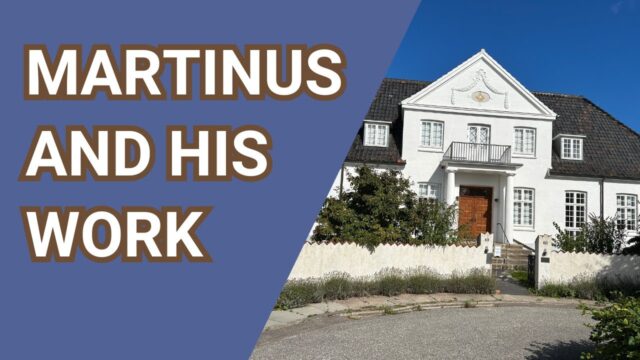
The last stretch turns to Martinus himself: a Danish writer who lived from 1890 to 1981 and produced something in the order of 6,000 pages, the principal work being Livets Bog, The Book of Life.
Then it ends on the question the whole system exists to answer, and the one the channel keeps returning to: who am I?
If that is the question that brought you here, the analysis of the living being is where it gets answered properly. If you would rather start with the man, there is a fuller account of Martinus.
Key ideas
- The channel exists to make Martinus' work usable by people who have never encountered it, not to argue for it.
- The main pieces are a spiritual world, reincarnation, karma, evil as missing knowledge, and life made entirely of living beings.
- Martinus presented his work as spiritual science: logical statements to be followed and checked, not doctrine to be accepted.
- There is no membership and no requirement — the closing advice is to take what inspires you and leave the rest.
- Martinus (1890–1981) wrote roughly 6,000 pages, of which Livets Bog is the main work.
Chapters
- Intro
- The Eternal World Picture
- Existence of a spiritual world
- Reincarnation
- Karma
- Evil is a consequence of lack of knowledge
- Making peace
- The meaning of suffering
- Everything consists of living beings
- The meaning of life is to experience it
- Everything is very good
- A science and not a religion
- No membership
- Pursue what inspires you
- Who is Martinus?
- Martinus' work
- Who am I?
About this article. It summarises the video above from The Eternal World Picture. The writings of Martinus Thomsen are published by the Martinus Institute.